Czech is spoken by approximately 10.7 million people, primarily in the Czech Republic. The Czech community in Singapore is small but includes professionals in engineering, automotive, and technology sectors.
Czech companies in the automotive supply chain and precision engineering sectors have business ties with Singapore, and Czech professionals relocate for regional roles. Translation needs include educational transcripts, professional engineering certifications, and personal documents for employment applications. Business translation covers manufacturing quality documentation, automotive specifications, and compliance certificates for import into Southeast Asian markets.
Corporate communications, marketing collateral, brochures, website content, and advertising copy translated for the Singapore market.
Engineering manuals, software documentation, product specifications, patents, and technical reports with precise terminology.
Medical reports, clinical trial documents, patient records, pharmaceutical labels, and healthcare correspondence.
Contracts, court documents, affidavits, statutory declarations, powers of attorney, and regulatory filings.
Bank statements, audit reports, annual reports, tax documents, payslips, and financial compliance filings.
Government correspondence, policy documents, public sector reports, regulatory submissions, and official communications.
As in most Slavic languages, many words (especially nouns, verbs and adjectives) have many forms (inflections). In this regard, Czech and the Slavic languages are closer to their Indo-European origins than other languages in the same family that have lost much inflection. Moreover, Colloquial Czech differs considerably from the standard language, even in many morphological features.
The word order in Czech serves a similar function to sentence stress and articles in English. Often all the permutations of words in a clause are possible. While the permutations mostly share the same meaning, they differ in the topic–focus articulation. For example: Češi udělali revoluci (The Czechs made a revolution), Revoluci udělali Češi (It was the Czechs who made the revolution), and Češi revoluci udělali (The Czechs did make a revolution). Usually the word order follows the pattern based on importance of the words expressed – from the least important to the most important.1
Our Czech translators and proof-readers are Australian government accredited and ready to translate all types of Czech documents to English for use in Australia and worldwide.
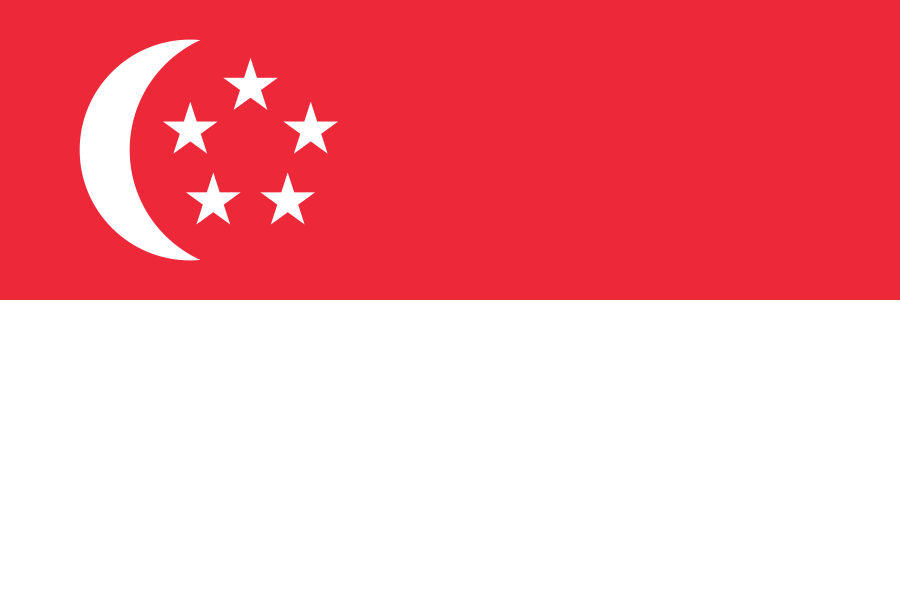 Singapore