Chinese is spoken by over 1.1 billion people worldwide across multiple dialect groups including Mandarin, Cantonese, Hokkien, and Teochew. In Singapore, Mandarin is one of the four official languages, spoken by approximately 75% of the resident population.
Singapore's Chinese community — the largest ethnic group at 74% — frequently requires translation for business contracts, property transactions, business documents, and communication with partners overseas. Chinese-English translation is in high demand for legal agreements, financial statements, academic transcripts, and marketing materials targeting the Greater China market. Singapore's position as Asia's financial hub means constant cross-border business between English and Chinese-speaking entities.
Corporate communications, marketing collateral, brochures, website content, and advertising copy translated for the Singapore market.
Engineering manuals, software documentation, product specifications, patents, and technical reports with precise terminology.
Medical reports, clinical trial documents, patient records, pharmaceutical labels, and healthcare correspondence.
Contracts, court documents, affidavits, statutory declarations, powers of attorney, and regulatory filings.
Bank statements, audit reports, annual reports, tax documents, payslips, and financial compliance filings.
Government correspondence, policy documents, public sector reports, regulatory submissions, and official communications.
The Chinese language (汉语/漢語 Hànyǔ; 华语/華語 Huáyǔ; 中文 Zhōngwén) forms one of the branches of Sino-Tibetan family of languages. About one-fifth of the world's population, or over one billion people, speaks some variety of Chinese as their native language. There are between 7 and 13 main regional groups of Chinese (depending on classification scheme), of which the most spoken, by far, is Mandarin (about 850 million), followed by Wu (90 million), Cantonese (Yue) (70 million) and Min (50 million). Most of these groups are mutually unintelligible, although some, like Xiang and the Southwest Mandarin dialects, may share common terms and some degree of intelligibility. 1
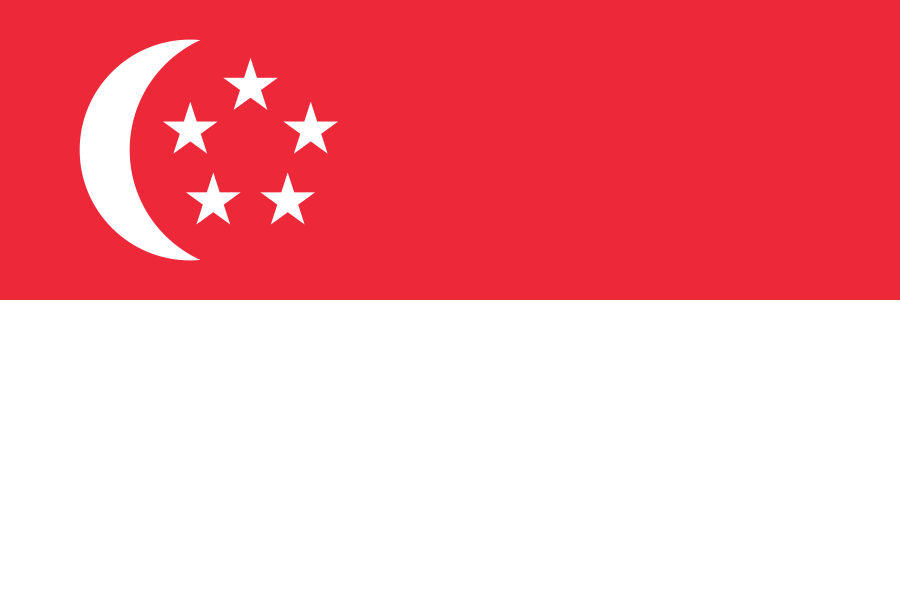 Singapore