Korean is spoken by approximately 80 million people in South Korea, North Korea, and diaspora communities worldwide. Singapore hosts around 20,000 Korean residents, with growing numbers drawn by business and education opportunities.
South Korea's economic ties with Singapore have strengthened significantly, with Korean companies like Samsung, Hyundai, and LG maintaining major regional headquarters here. Korean expatriates require translation for work permits, dependent pass applications, housing documents, and children's school records. The Korea-Singapore Free Trade Agreement has increased bilateral business translation demand for contracts, compliance documents, and financial reporting.
Corporate communications, marketing collateral, brochures, website content, and advertising copy translated for the Singapore market.
Engineering manuals, software documentation, product specifications, patents, and technical reports with precise terminology.
Medical reports, clinical trial documents, patient records, pharmaceutical labels, and healthcare correspondence.
Contracts, court documents, affidavits, statutory declarations, powers of attorney, and regulatory filings.
Bank statements, audit reports, annual reports, tax documents, payslips, and financial compliance filings.
Government correspondence, policy documents, public sector reports, regulatory submissions, and official communications.
Korean is the official language of the country Korea, in both South and North. It is also one of the two official languages in the Yanbian Korean Autonomous Prefecture in People's Republic of China. There are about 78 million Korean speakers worldwide. In the 15th century, a national writing system was commissioned by Sejong the Great, the system being currently called Hangul. Prior to the development of Hangul, Koreans had used Hanja and phonetic systems like Hyangchal, Gugyeol and Idu extensively for over a millennium. However, it was not until the 20th century that Hangul became the dominant national script, given the yangban class's preference of the Hanja system.
Some linguists, most notably Alexander Vovin, have argued that the indicated similarities between Japanese and Korean are not due to any genetic relationship, but rather to a sprachbund effect and heavy borrowing, especially from ancient Korean into Western Old Japanese. A good example might be Middle Korean sàm and Japanese asa "hemp". This word seems to be a cognate, but while it is well-attested in Western Old Japanese and Northern Ryūkyū, in Eastern Old Japanese it only occurs in compounds, and it is only present in three sub-dialects of the South-Ryūkyūan dialect group. Then, the doublet wo "hemp" is attested in Western Old Japanese and Southern Ryūkyū. It is thus plausible to assume a borrowed term.1
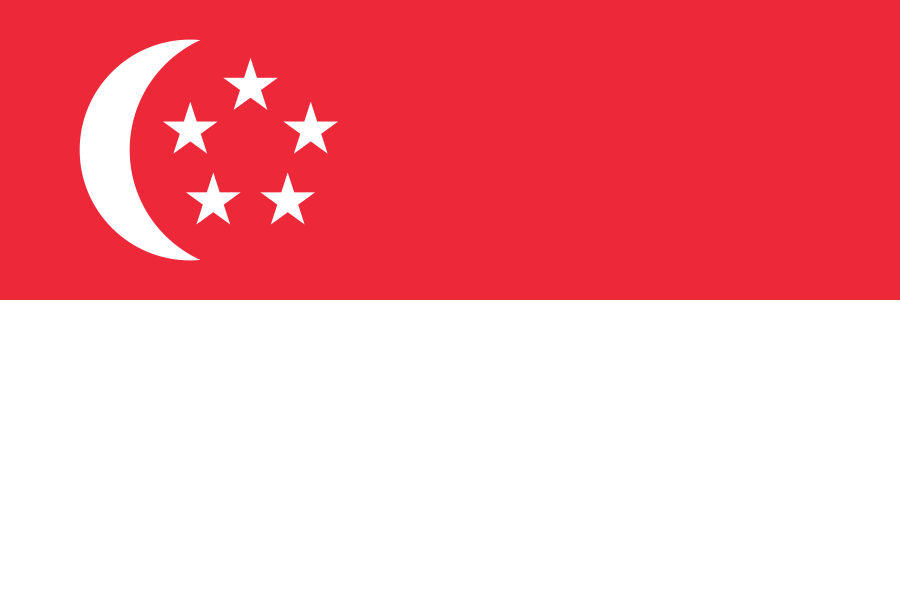 Singapore