Serbian is spoken by approximately 12 million people in Serbia, Bosnia and Herzegovina, Montenegro, and diaspora communities. Serbian uses both Cyrillic and Latin scripts — the only European language with active digraphia.
Serbian professionals in Singapore work across IT, engineering, and financial services. Translation needs include university degrees and professional qualifications for Singapore credential recognition, as well as personal documents for employment pass applications. The dual-script nature of Serbian — Cyrillic for official documents and Latin for everyday use — means translators must be proficient in both scripts for accurate document translation.
Corporate communications, marketing collateral, brochures, website content, and advertising copy translated for the Singapore market.
Engineering manuals, software documentation, product specifications, patents, and technical reports with precise terminology.
Medical reports, clinical trial documents, patient records, pharmaceutical labels, and healthcare correspondence.
Contracts, court documents, affidavits, statutory declarations, powers of attorney, and regulatory filings.
Bank statements, audit reports, annual reports, tax documents, payslips, and financial compliance filings.
Government correspondence, policy documents, public sector reports, regulatory submissions, and official communications.
Serbian is a form of Serbo-Croatian spoken by Serbs in Serbia, Bosnia and Herzegovina, Montenegro, Croatia, Albania, and neighbouring countries. In particular, Serbian is standardized around Šumadija-Vojvodina and Eastern Herzegovinian subdialects of Shtokavian. The other dialect spoken by Serbs, Torlakian, is spoken in southeast Serbia. Serbian is the only European language with active digraphia, using both Cyrillic and Latin alphabets. The Serbian Cyrillic alphabet was devised in 1814 by Serbian linguist Vuk Karadžić, who created the alphabet on phonemic principles.
Serbian is a form of Serbo-Croatian, a Slavic language (Indo-European), of the South Slavic subgroup. Serbo-Croatian consists of Serbian along with Bosnian, Croatian, and Montenegrin. It has lower intelligibility with the East South Slavic languages Bulgarian and Macedonian, than with Slovene (although Slovene is part of the West subgroup, it is hindered by differences in vocabulary, grammar and pronunciation to the Serbo-Croatian standard forms, and is closer to the Serbo-Croatian Kajkavian and Chakavian dialects1
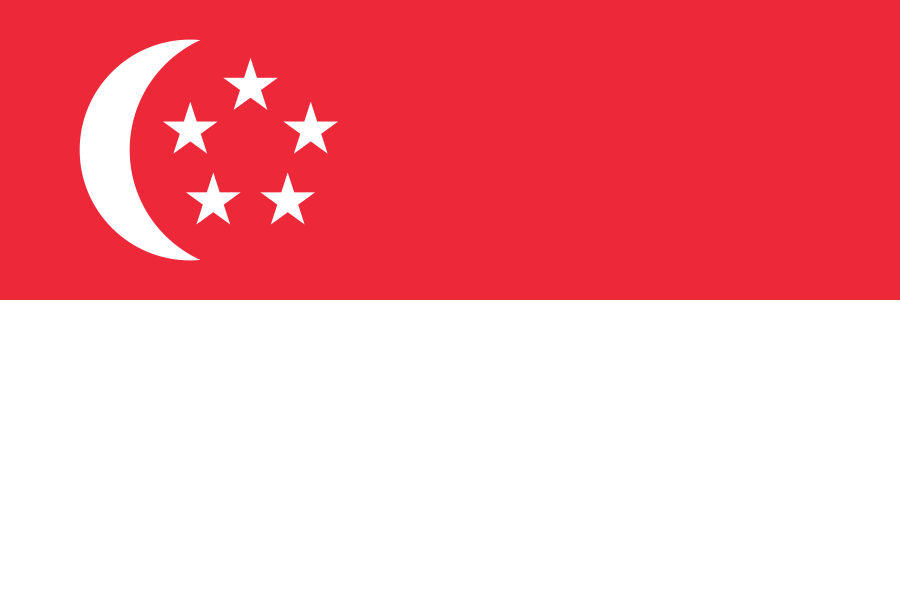 Singapore